Washington Square
The King in YellowWashington Square is both a recognizable New York setting and a compressed image of the society that surrounds it. Under its lawns, fountains, statues, barracks, and promenades lies a political order that has made death administrative: the square contains the first Government Lethal Chamber, while also serving as the viewpoint from which Hildred Castaigne watches the city, rehearses his imperial fantasies, and witnesses the disturbing passage of a voluntary victim. Its beauty and its menace are deliberately placed side by side.
Setting and Civic Transformation
Washington Square appears as a carefully maintained public landscape rather than an untouched historic site. The surrounding city has undergone sweeping political and social changes, including the dismantling of the Elevated Railroads, the removal of the Dodge Statue, and the repeal of the laws prohibiting suicide. The square therefore belongs to a New York whose apparent calm and prosperity depend on centralized authority and on policies that redefine social disorder as something to be managed.
The site of the Lethal Chamber had formerly been a block of shabby buildings occupied by cafés and restaurants serving foreigners. The Government acquired it in the winter of 1898, demolished the French and Italian establishments, enclosed the entire block with a gilded iron railing, and converted it into a garden of lawns, flowers, and fountains. This replacement of immigrant commercial life by a state-controlled ornamental enclosure gives the square a distinctly political geometry: public improvement and exclusion are accomplished through the same act of clearance.
At the centre of the new garden stands a small white building in severe classical style. Six Ionic columns support its roof, and its only entrance is a bronze door. Before it stands a marble group of The Fates, made by the young American sculptor Boris Yvain, who died in Paris at the age of twenty-three. The building presents death through the language of architecture, sculpture, and ceremony, making the lethal institution resemble a temple whose classical dignity conceals its function.
The Lethal Chamber and Public Spectacle
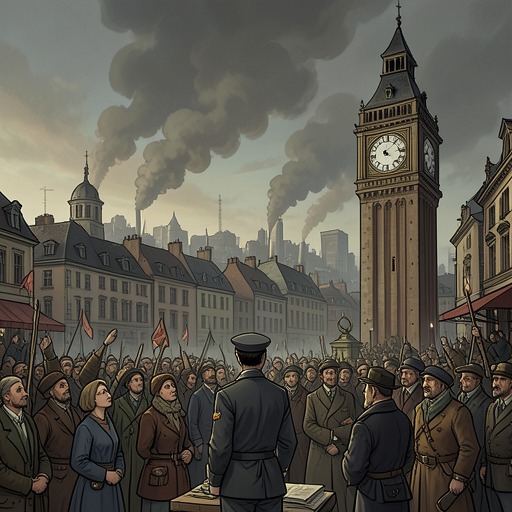
The first Government Lethal Chamber was established on April 13, 1920, on the south side of Washington Square between Wooster Street and South Fifth Avenue. Its inauguration turns the square into a controlled public theatre. A cordon of police prevents ordinary spectators from approaching, while a regiment of United States lancers forms a hollow square around the building. On a raised tribune facing the park stand the Governor of New York, the Mayors of New York and Brooklyn, senior police and military officers, Colonel Livingston, General Blount, Major-General Hamilton, Admiral Buffby, Surgeon-General Lanceford, members of the National Free Hospital staff, Senators Wyse and Franklin, and the Commissioner of Public Works. Hussars of the National Guard surround the tribune.
The ceremony openly recasts self-destruction as a public service. The Governor declares that the laws prohibiting suicide and punishing attempted self-destruction have been repealed, because the Government recognizes a person's right to end an existence made intolerable by physical suffering or mental despair. He further states that the community may benefit by removing such people from its midst and announces plans for a Lethal Chamber in every city, town, and village. The square thus stages a moral reversal: what was formerly treated as a punishable act is now presented as an organized civic relief, and the military display gives that claimed compassion the force of discipline.
The Chamber's placement beside a garden is crucial to its effect. From a distance, the grounds are lovely and serene; the fountains sparkle, the paths lie among flowers, and the classical building appears almost harmless. Yet the same setting turns spectators into witnesses to an institution whose purpose is death. The contrast makes the square less a place of reconciliation than a carefully landscaped threshold between ordinary public life and state-sanctioned disappearance.
Hildred Castaigne's Viewpoint
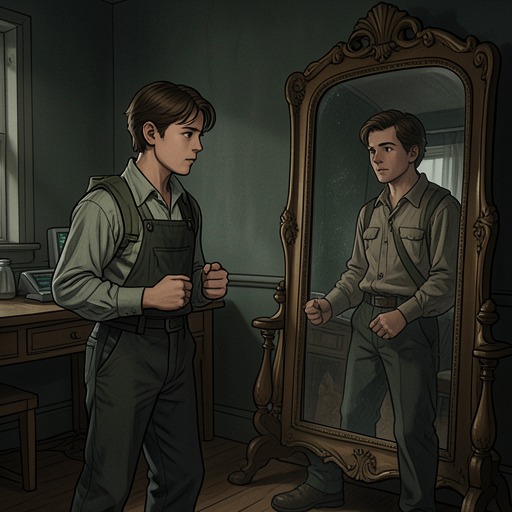
Hildred Castaigne repeatedly moves through the square, and his relation to it changes from casual observation to obsessive symbolic possession. After leaving Mr. Wilde's rooms, he walks along Bleecker Street, skirts the grounds of the Lethal Chamber, crosses Washington Park, and returns to his rooms in the Benedick. His apartment faces the square, giving him a private vantage over a public landscape. He reads the newspapers, opens his steel safe, and handles the golden, diamond-bright diadem that he believes is reserved for the royal servant of The King in Yellow. The square outside becomes the stage beneath his imagined sovereignty.
From his window Hildred sees the Chamber's railing, the fountains, the flower beds, and the white peacocks. A drab pigeon sits so still on the arm of one of The Fates that it seems part of the stone. The calm image is interrupted when a nervous young man enters the grounds, pauses before the marble faces, presses a hand to his face, and rushes through the bronze doors. Half an hour later the loiterers have gone, and the frightened pigeon returns to its perch. The event is not explained by any official announcement or visible aftermath; the building's silence is precisely what makes the act terrifying. The square absorbs a human decision and restores its ornamental stillness.
Later, Hildred waits in the square at night. The military surroundings become more prominent as the mounted sentry is changed twice, the barracks lights go out one by one, the gate closes, and officers pass through the wicket with the rattle of equipment and the jingle of spurs. At midnight, a figure crosses into the square and approaches the Benedick. Hildred calls out to Louis Castaigne, and the quiet civic setting becomes the point of departure for the violent confrontation that follows.
Violence Beneath the Order
The Chamber's presence gives Hildred's private violence an ominous public backdrop. During his confrontation with Louis Castaigne, Hildred describes the fate he claims awaits Dr. John Archer and laughs when he thinks of Osgood Oswald Vance, his knife, and the order bearing Hildred's signature. He announces his belief that he will become King and that Louis has stood in the way of his empire. At that moment, Osgood Oswald Vance runs through the gate of the Lethal Chamber and plunges into the death chamber, prompting Hildred to conclude that Hawberk and his daughter no longer obstruct him.
The square therefore links two forms of lethal authority. The Government's Chamber presents death as regulated, impersonal, and ceremonially legitimate; Hildred imagines murder, conspiracy, and execution as instruments of personal monarchy. His shouted imperial claims transform the surrounding civic architecture into an arena for delusion. When Louis flees after Hildred threatens him, the path from the square leads directly into the streets and toward Hawberk's shop, showing how quickly the ordered public space gives way to pursuit and domestic danger.
Seasonal and Emotional Contrasts
Washington Square is not represented by a single atmosphere. In spring, Hildred sees tender foliage on the elms and maples, pigeons circling the Memorial Church, gardeners turning the earth, watering-carts spraying the drives, children playing near the statue of Peter Stuyvesant, and dragoon troopers resting on benches. The Washington Memorial Arch shines in the sun, while the barracks and artillery stables at the eastern edge remain active with colour and movement. This abundance of ordinary life makes the nearby Chamber more disturbing, because death is not isolated in a remote prison or battlefield; it stands among children, flowers, animals, and leisure.
In another narrative strand, Washington Square is associated with memory, music, and involuntary emotional recurrence. The roar of Broadway can call before the painter's mind an image of a Breton forest, while the Mass of Sainte Cécile evokes subterranean caverns; the square likewise gathers everyday movement around the artist's studio and the repellent figure of the church watchman. The place functions as a surface on which distant landscapes and buried experiences appear without warning.
Its winter and wartime echoes are harsher. The bitter cold, metallic street sounds, sleet, and grey skies that cross the broader narrative establish a city whose public spaces are exposed to deprivation and dread. In the Paris siege episodes, the pressure of bombardment, hunger, waiting, and military collapse turns urban space into a register of collective vulnerability. Washington Square's polished New York order stands in implicit contrast to that besieged world, but the Chamber reveals that the apparently peaceful city has not escaped violence; it has domesticated and administered it.
Narrative Significance
Washington Square binds together politics, architecture, spectatorship, and unstable consciousness. It is a park, a military-adjacent civic precinct, a view from Hildred's rooms, and the site of an institution designed to make death appear rational. The narrative repeatedly moves between open lawns and closed doors, fountains and bronze entrances, public ceremony and private fantasy. Each contrast exposes the fragility of the social order that the square seems to embody.
The location's decisive function is to make the extraordinary look ordinary. A young man can enter the Chamber, the crowd can wait, the pigeon can return to The Fates, and the gardeners can continue their work. Yet beneath this restored calm lies an irreversible act that the landscape cannot explain away. Washington Square consequently becomes a central emblem of a civilization that has exchanged visible chaos for controlled violence: its surfaces are beautiful, its rituals are orderly, and its deepest institutions remain haunted by death.